BONFIRE NIGHT: A VERY BRITISH TRADITION!
Every year, on 5th November, towns and villages across Britain light up the night sky with spectacular fireworks, enormous bonfires and the occasional burning politician. But what exactly are the British celebrating, and why does one man called Guy Fawkes still play such an important role in this rather unusual national tradition?
A plot that nearly changed British history
Imagine London in November 1605. King James I is on the throne, religious tensions are running high, and a group of English Catholics are becoming increasingly frustrated with the treatment of their community. They believe that the Protestant government is discriminating against them and restricting their religious freedom. Some of them decide that peaceful protest is no longer an option. Instead, they come up with an extraordinary and extremely dangerous plan. Their objective? To blow up the Houses of Parliament, kill the King and as many members of the government as possible, and replace the existing regime with a Catholic monarchy. The plan, which became known as the Gunpowder Plot, was organised by a group of conspirators led by Robert Catesby. However, the man whose name would become forever associated with the event was Guy Fawkes, an experienced soldier who had fought in Europe. The conspirators secretly rented a cellar beneath the Houses of Parliament and managed to store 36 barrels of gunpowder there. Their intention was to set off an enormous explosion on 5th November 1605, the day King James was due to open Parliament. But their carefully prepared plan was about to go horribly wrong.
The man with the matches
Guy Fawkes was given the task of guarding the explosives and lighting the fuse when the moment came. However, just hours before the planned attack, an anonymous letter warning a member of Parliament to stay away from the building reached the authorities. The government ordered a search of the cellars. On the night of 4th November, soldiers discovered Guy Fawkes hiding near the barrels of gunpowder, together with matches and other equipment. He was immediately arrested. Under interrogation and torture, Fawkes eventually revealed the names of his fellow conspirators. Several were killed while resisting arrest, while others were captured, tried and sentenced to death. Guy Fawkes was executed in January 1606. The Gunpowder Plot had failed, and King James I had survived. To celebrate the King’s escape, people were encouraged to light bonfires across the country on the evening of 5th November. What began as a celebration of the survival of the monarchy gradually developed into an annual British tradition.
Remember, remember the Fifth of November!
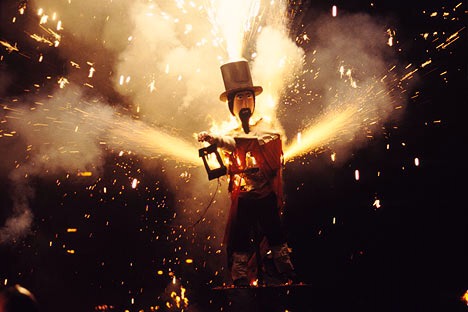
More than four centuries later, Bonfire Night is still celebrated throughout the United Kingdom. The occasion is also known as Guy Fawkes Night or Fireworks Night. One of the most famous traditions is the burning of a Guy: a homemade model representing Guy Fawkes. Traditionally, children would make these figures using old clothes stuffed with newspaper or straw. They would then take them into the streets and ask passers-by for money by shouting: « Penny for the Guy! » The money collected was traditionally used to buy fireworks. Although this custom has largely disappeared, the expression remains part of British cultural history. At organised celebrations, the Guy is sometimes placed on top of a huge bonfire and set alight. The fireworks exploding overhead are a symbolic reminder of the gunpowder that was supposed to destroy Parliament in 1605. Another familiar feature of the evening is a short poem that many British people learn as children:
« Remember, remember the Fifth of November,
Gunpowder, treason and plot.
I see no reason why gunpowder treason
Should ever be forgot. »
It is one of those little pieces of British history that has survived through generations.
From local bonfires to spectacular firework displays
Today, Bonfire Night is less about politics and religion and more about having fun with family and friends. Across Britain, local councils, charities and community organisations arrange public celebrations, often attracting thousands of visitors. Some events feature enormous bonfires, live music, food stalls, fairground attractions and impressive firework displays. Others are much smaller, with families and neighbours gathering in gardens to enjoy the evening together.
What do the British eat on Bonfire Night?
There is one thing you can almost guarantee about a November evening in Britain: it will probably be cold, damp and possibly raining. Nevertheless, that doesn’t stop people from spending hours outside watching fireworks. Warm clothing is essential, and so is something hot to eat! One of the most traditional Bonfire Night dishes is the humble baked potato. Cooked in the oven or wrapped in foil and heated over the fire, it is usually served with butter, grated cheese, baked beans or other toppings. Sweet treats are equally important. Toffee apples, made by coating apples in a hard layer of caramelised sugar, are a familiar sight at firework displays and fairgrounds.
In northern England, another traditional favourite is parkin, a sticky ginger cake made with oatmeal, flour, black treacle and golden syrup. Its rich flavour makes it particularly suitable for a cold autumn evening. And, of course, there are marshmallows! Children and adults alike enjoy toasting them over the fire until they become soft, golden and slightly crispy on the outside. Just be careful not to drop yours into the flames!
Safety first: fireworks are not toys
Although fireworks are an essential part of Bonfire Night, they can be extremely dangerous if they are handled incorrectly. In the past, fireworks were much more freely available, and children could even buy them in local shops. These days, the rules are considerably stricter. In England and Wales, for example, you must generally be at least 18 to buy most consumer fireworks, and there are restrictions on when they can be used. Organised public displays are usually the safest way to enjoy the celebrations. People attending private events are advised to follow the instructions on fireworks, keep a safe distance and never return to a firework that has failed to go off. There are other concerns too. Fireworks can frighten pets, disturb wildlife and create considerable noise and air pollution. For this reason, some people prefer quieter displays or alternative celebrations using lights and other special effects.
A tradition that refuses to fade away
Bonfire Night has changed considerably since 1605. What was originally a politically and religiously charged celebration has evolved into a much more light-hearted community event. Nevertheless, its historical origins have not been forgotten. The Houses of Parliament still stand in London, although the original buildings were largely destroyed by fire in 1834 and subsequently rebuilt. The annual State Opening of Parliament continues to take place, with the monarch formally opening a new parliamentary session. And every November, as fireworks illuminate the British sky, the story of Guy Fawkes is remembered once again. So, whether you prefer a spectacular professional firework display, a cosy evening with baked potatoes and toffee apples, or simply watching the celebrations from your window, there is something rather special about this distinctly British autumn tradition.
Remember, remember the Fifth of November!